


How AI Is Disrupting (not just transforming) Learning in the Organisation
3 hours ago
7 min read
From Training to Learner-Driven, AI-Enabled Capability
Lets start with the definition of Learning
“Learning is the process of acquiring new knowledge, behaviors, skills, values, or attitudes through study, experience, or instruction”
Across the decades, while the Why and What of learning remained the same , the How of Learning evolved. And many years, learning in organisations followed a predictable model.
The organisation decided what employees needed to learn.L&D designed the programme. Employees attended a course, completed an e-learning module, passed an assessment and in some instances had to show application of learning back at work .
Much of corporate learning was built around training catalogues, classrooms, compliance requirements, structured programmes and completion rates.
That model changed more than a decade ago with the accelerated adoption of digital technologies.
Across the years, I have been advocating on Future of Learning in the Digital Age is becoming increasingly democratized, learner-driven, contextual, continuous and embedded into the work itself enabled by digital technologies.
In the last 2 years alone, Artificial Intelligence, and particularly Generative AI, has not only accelerated the Digital transformation of Learning but completely disrupted it.
“disrupting how people access knowledge, develop capability and apply what they know to achieve outcomes instantly.”
From Training to Learning on Demand
Digitisation was the first major transformation.
Classrooms became virtual classrooms. Training manuals became e-learning. Learning Management Systems created centralised repositories. Video, mobile learning, podcasts, microlearning and Learning Experience Platforms made content available anytime and anywhere.
But initially, much of this was simply digitising the traditional training model.
The course still existed. The organisation still largely determined what the learner should consume.
Then consumer technology began changing our behaviour.
Google gave us instant answers. YouTube allowed us to learn almost anything visually. Spotify and podcasts enabled learning while travelling. TikTok, Instagram and other social platforms introduced highly personalised, short-form content driven by algorithms that continuously learn what users find relevant.
This has influenced how people expect information to reach them at work.
The so-called “TikTok environment” is not simply about shorter attention spans.
It is about expectations of:
relevance, immediacy, personalisation, choice and control.
The modern employee increasingly asks:
· “Why should I complete a 45-minute course when I need the answer to one question?”
· “Why should everyone attend the same programme when our experience levels are different?”
· “Why should I wait until next month for training when I need the knowledge now?”
This is particularly visible among younger generations entering the workforce.
Deloitte’s research on Gen Z and Millennials consistently highlights the importance younger employees place on continuous development, practical experience, mentorship and learning that contributes directly to career progression.
They are not rejecting learning.Quite the opposite.
“They expect learning to be available when it is relevant to them.”
Then Generative AI Changed the Equation

Generative AI takes this transformation much further.
Previously, digital learning still required someone to create the content before somebody else could consume it.
Today an employee can open an AI assistant and ask:
· “Explain this concept.”
· “Give me an example relevant to my industry.”
· “Summarise this document.”
· “Test my understanding.”
· “Role-play a difficult customer.”
· “Challenge my recommendation.”
· “Help me prepare for tomorrow’s presentation.”
The learner is no longer simply searching for learning.
The learner can generate a learning experience through conversation.This is a significant shift.
Josh Bersin has described the evolution of corporate learning as moving beyond static training towards what he calls Dynamic Enablement.
The idea is important.
Instead of seeing learning primarily as publishing courses, organisations increasingly need to enable employees to access the knowledge, expertise, coaching, tools and support required to perform at the moment both at work and off work. In other words:
“Learning is enabled dynamically into the fabric of work.”
Instant Information Is Not the Same as Learning

This is where I believe organisations need to be careful.
Generative AI gives us unprecedented access to information. But access to information does not automatically create capability.
A manager can ask AI how to conduct a difficult performance conversation. That does not mean the manager can successfully have that conversation.
A salesperson can ask AI for ten negotiation techniques. That does not mean the salesperson can recognise the right moment to use them.
An engineer can receive an explanation of a technical problem. That does not necessarily mean the engineer can diagnose and resolve it safely in a real environment.
There is a critical journey between information and performance.
Information → Understanding → Practice → Feedback → Application → Reflection → Capability → Outcome
AI can dramatically accelerate the first stages. But organisations still need to design the rest.
This, in my view, is where Learning & Development becomes even more important.
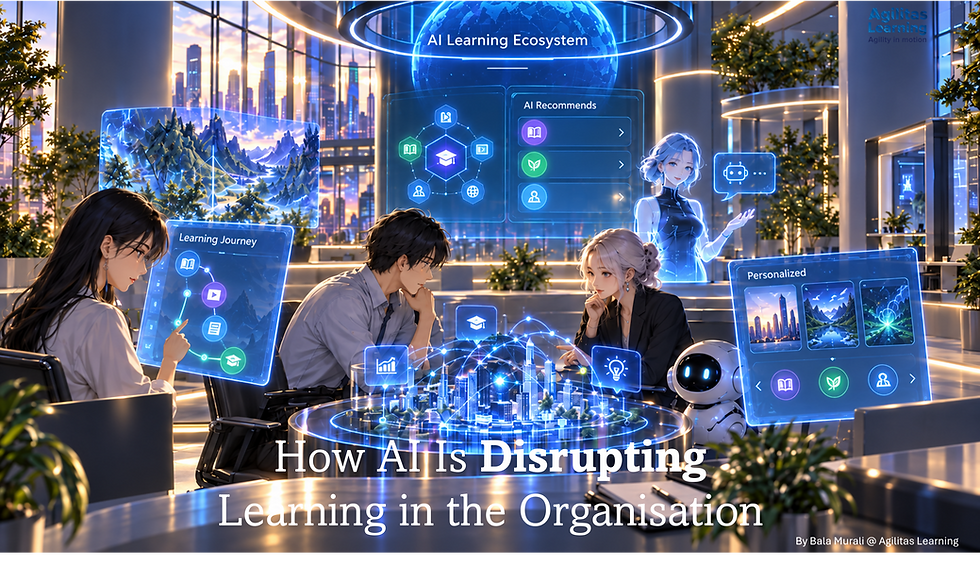
Where the organization needs to create a Digital Learning Ecosystem and L&D becomes the Learning Architects.
The Role of L&D has changed

The traditional L&D function was often seen as a producer and administrator of training.
The future L&D function needs to become an Architect of organisational capability.
The question changes from:
“What courses should we provide?” to: “What must our people be able to do for the organisation to succeed?”
And then:
“What combination of learning, experience, AI, coaching, knowledge, practice and collaboration will help them do it?”
That changes the role of the learning practitioner. The future practitioner is not simply an instructional designer or course developer. Increasingly, they become primarily the Learning Architect and take on other roles as: Performance Consultant , Capability Strategist, Knowledge Curator ,AI-enabled Learning Ecosystem Builder.
The learning ecosystem itself also becomes much more diverse and organic.
An employee may learn from a formal course -then from an AI coach- colleague-an online community- a simulation- by applying something in a live project and reflecting with their manager on the learning and outcome.
L&D does not need to create every learning experience. Its role is increasingly
“to architect the environment in which meaningful learning can happen.”
We Are Already Seeing This Happen
There are some good examples emerging.
Visa has used AI-enabled coaching to allow employees to practise sales conversations and receive automated feedback before facing real customers.
Siemens has created a large learning and career ecosystem (My Learning world) that connects employee skills, development opportunities, career pathways and personalised learning recommendations.
IBM has applied AI not only to learner experiences but also to the operation of L&D itself, automating administrative activities so learning teams can spend more time on higher-value work.
The lesson from these cases is important.
The biggest opportunity is not simply: “How can AI help us create courses faster?”
It is:
“How can AI help employees learn, practise, solve problems and perform better?”

The Future May Not Begin With a Course
Perhaps one of the biggest changes will be the convergence of learning and organisational knowledge.
Imagine an employee encountering a problem.
Instead of asking: “Is there a course on this?” they ask: “How do we solve this problem in our organisation?”
An enterprise AI assistant could potentially draw from approved policies, procedures, learning content, previous projects, expert knowledge, case studies and organisational experience.
At that point, the employee may not care whether the answer came from : LMS, knowledge-management system or document repository.
They care whether it helps them perform.
“Boundaries between learning, knowledge management, performance support and work itself begins to blur”

But AI Also Introduces New Risks
The opportunity is significant. So are the risks.
Generative AI can produce incorrect or fabricated information.
Employees may unknowingly enter confidential company information into public AI systems.
AI-generated content may contain bias, outdated information or intellectual-property concerns.
Cybersecurity risks such as prompt injection and sensitive-data exposure also need to be considered.
The danger is particularly significant where AI-generated information relates to safety, regulation, engineering, finance, healthcare or critical business decisions.
This means AI literacy must go much further than teaching people how to write prompts.
Employees need to understand: how to verify information, which AI platforms are approved, what information should never be entered, when human review is required, where authoritative information resides and who remains accountable for the final decision.
My previous article “Guide the Fear of AI” main theme was bringing the argument that Human still have to be in control and accountable in the Age Of AI. The fundamental principle should remain:
“AI may inform human judgement. Perform task.But it should not remove human accountability.”

What Should L&D Do Now?
I believe there are seven practical moves L&D leaders should begin making.
1. Move from learning strategy to capability strategy.Start with what people must be able to do, not what training they need to take.
2. Map the real learning ecosystem.Understand where employees actually learn—courses, colleagues, managers, projects, communities, AI tools, search and experience.
3. Introduce AI at the point of need.Explore AI coaching, simulations, personalised recommendations, conversational learning, skills assessment and performance support.
4. Design for application.Ask one question of every major learning intervention:“What will people be able to do differently?”
5. Build AI literacy.Teach employees not only how to use AI but how to question it, verify it and use it responsibly.
6. Develop Learning Architects.Build L&D capability across learning science, performance consulting, technology, data, AI, knowledge architecture and business understanding.
7. Change the measures.Move beyond completion rates toward proficiency, application, productivity, speed to competence, behaviour change and business outcomes.

In Conclusion : Ask the right Question
Much of the discussion today asks: “What will AI do to Learning & Development?”
Perhaps the more interesting question is: “What will learning become when information and intelligent assistance are available almost instantly?”
The future employee may continuously move between working, asking, discovering, practising, collaborating, reflecting and performing.
Sometimes they will learn from a person, other times from a course ,from experience or from AI. And increasingly, from all of them together.
That does not make L&D less relevant. It makes its purpose clearer.
· Move from managing courses to architecting capability.
· Move from delivering content to enabling performance.
· Move from measuring participation to measuring outcomes.
"Because in the AI age, competitive advantage may increasingly belong to the organisation that can architect AI to enable workforce to learn, unlearn, adapt and apply knowledge faster than everyone else and ultimately translate that into performance and business outcome successfully.”

Source Reference :Josh Bersin and The Josh Bersin Company on Dynamic Enablement and AI-native corporate learning; Deloitte’s Gen Z and Millennial Survey and Digital Media Trends; LinkedIn Workplace Learning Report; World Economic Forum Future of Jobs Report 2025; case studies and research from IBM, Visa and Siemens; and AI governance guidance from NIST, UNESCO and OWASP, Agilitas Learning Future of Learning, Guide the Fear of A.I.
Comments